Home › Commercial Concrete Contractor Services
Superior Concrete Denver offers comprehensive commercial concrete contractor services in Denver, CO. We partner with general contractors, owners, and property managers to deliver flatwork, foundations, site concrete, and repairs on schedule with professional project coordination and communication.
Superior Concrete Denver provides professional commercial concrete contractor throughout Denver, CO, Colorado and the surrounding area. Our licensed, insured crew delivers safe, clean, on-time work with a free estimate before anything begins. Call (970) 648-8412 or request your free quote.
Commercial Concrete Built for Denver Businesses
Superior Concrete Denver provides full-service commercial concrete contractor solutions across the Denver metro area and the Front Range. We focus on structures and flatwork that must handle real loads: forklifts, delivery trucks, pallet racks, heavy foot traffic, freeze-thaw cycles, and de-icing salts.
Our team starts every project with a detailed site evaluation, not a stock bid. We check subgrade conditions, drainage paths, snow storage areas, and how the space will actually be used. A restaurant patio with freeze-thaw exposure and constant spills needs different finishing and sealing than a warehouse slab with steel racking and narrow-aisle forklifts.
We routinely coordinate with owners, GCs, and engineers on permitting, structural drawings, and inspections. Whether you are pouring a new warehouse slab, replacing failed store-front sidewalks, or adding loading docks, we plan the concrete scope so it fits with your schedule, budget, and long-term maintenance expectations.
Core Commercial Concrete Services We Offer
Our work covers most concrete needs a Denver commercial property will encounter:
• Structural and slab-on-grade floors for warehouses, manufacturing, shops, and self-storage facilities
• Parking lots and drive lanes, including dumpster pads, service roads, and fire lanes
• Sidewalks, ADA-compliant ramps, and curb-and-gutter along city streets or private drives
• Concrete pads for rooftop unit ground sets, generators, chillers, trash enclosures, and communication equipment
• Retaining walls and stem walls around loading docks, truck courts, and grade changes
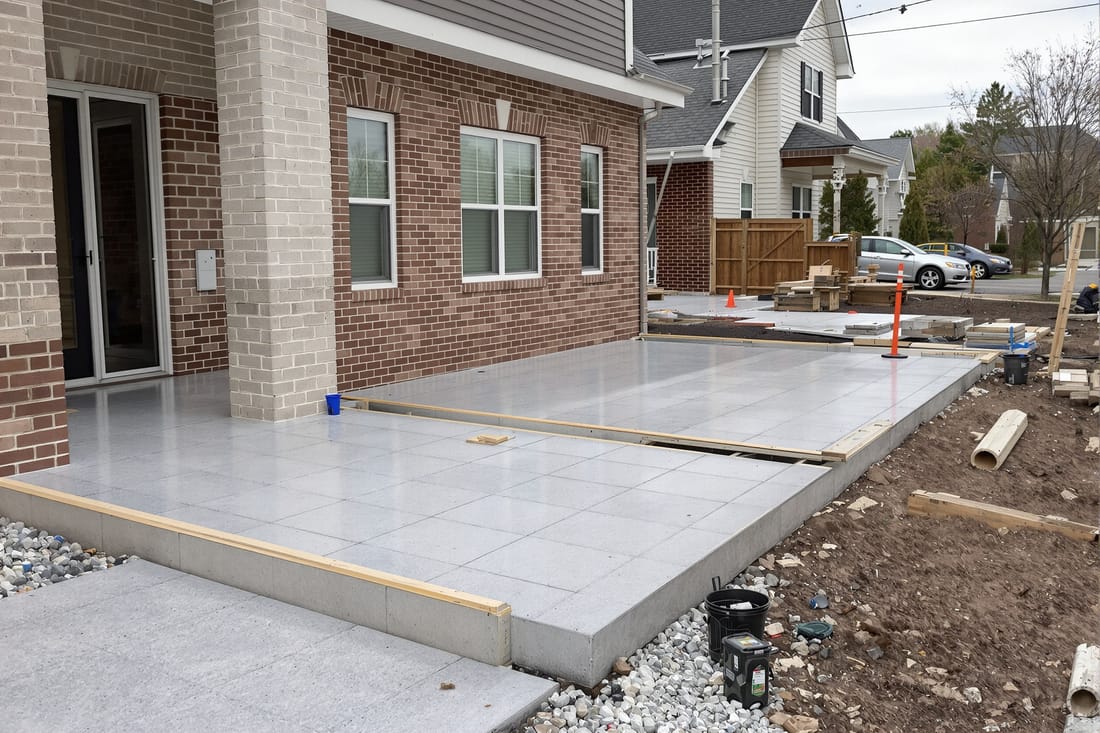
• Commercial patios and common areas for restaurants, multi-family, and office buildings
On new builds we typically work from stamped structural drawings, but on smaller commercial projects like tenant improvements, storage yards, or pad replacements we can help you develop a practical scope. Superior Concrete Denver coordinates with utility locators, surveyors, and other trades so concrete work does not delay your schedule.
How We Plan and Pour Commercial Slabs and Flatwork
A durable commercial slab in Denver starts with subgrade and drainage. We proof-roll or probe-test the base to locate soft spots, then undercut or stabilize those areas with compacted road base or structural fill. Denver soils can vary from sandy to expansive clay even on a single property, so we do not assume one preparation method fits everywhere on the site.
Next, we install formwork that sets elevations and slopes. For exterior flatwork we usually design a minimum 1 to 2 percent slope away from the building to keep water from collecting along foundations or doorways. In loading areas we verify approach and dock heights so trucks can back up without bumper damage.
Reinforcement is selected based on actual loading. For light-duty sidewalks we may use rebar only at transitions and around features like light poles. For warehouse slabs exposed to point loads and racking, we typically use a combination of welded wire reinforcement or rebar and proper joint layout to control cracking. For high load pads such as dumpster or compactor pads, we often increase thickness and reinforcement density.
We place concrete using chute, pump, or buggy depending on site access. Proper consolidation, screeding, and bullfloating are done immediately. Finish options vary: broom finish for exterior slip resistance, steel-trowel or power-trowel finish for interiors, and specialty finishes for decorative commercial spaces.
Control and isolation joints are cut or tooled to specific spacing based on slab thickness and panel dimensions. In Denver’s climate, good joint design is what keeps random cracking from becoming a long-term appearance and performance problem.
Concrete Mixes and Finishes Designed for Denver’s Climate
Concrete in Denver must withstand large temperature swings, snow events, and de-icing chemicals. Superior Concrete Denver works with suppliers to use mixes suitable for local conditions, not just generic 4,000 psi concrete.
For most exterior commercial slabs we use air-entrained mixes in the 4,000 to 4,500 psi range, which stand up better to freeze-thaw cycles. Parking lots, drive lanes, and dumpster pads often receive higher strength mixes or thicker sections because of truck traffic and plow impacts.
Interior commercial slabs in warehouses and retail spaces often use mixes optimized for flatness and early strength, especially when racking, equipment, or build-out work must follow soon after the pour. We consider joint layout, curing method, and floor flatness (FF/FL) requirements if you have narrow-aisle forklifts or sensitive equipment.
Finish choices include: standard broom or light broom for exterior walks and drive lanes, troweled or burnished finishes for industrial interiors, and integrally colored, stamped, or exposed aggregate finishes for patios and entry plazas. In high-traffic or food-service areas we usually recommend a sealing or coating system designed for chemical resistance and easier cleaning.
Because Denver uses magnesium chloride and other de-icers, we often recommend a penetrating sealer for exterior slabs after they have cured adequately. This is a relatively low-cost step that significantly extends the life of sidewalks and parking areas.
Cost Drivers and Budget Planning for Commercial Concrete
Commercial concrete pricing is driven by more than square footage. For a realistic budget, we look at:
• Thickness and reinforcement: A 6 inch reinforced slab or dumpster pad costs more than a 4 inch sidewalk because of concrete volume, steel, and labor.
• Access and staging: Downtown Denver or tight infill sites may need pumps, traffic control, or night pours. Easier access at suburban properties can reduce those costs.
• Subgrade conditions: Poor or variable soils, buried debris, or overexcavation needs will add base material and compaction time.
• Demo and removal: Replacing failed concrete requires sawcutting, breaking, hauling, and possible utility adjustments underneath.
• Finishes and curing: Stamped, exposed aggregate, colored concrete, or special curing and joint-filling requirements increase labor and material.
Superior Concrete Denver provides itemized proposals so you can see how each part of the scope affects price. On larger projects we can often phase work to reduce disruption to tenants or operations, which sometimes saves on temporary access and traffic-control costs.
Common Problems We Fix on Existing Commercial Concrete
Many of our projects in Denver involve repairing or replacing failing commercial concrete. Common issues include settled or heaved sidewalks that create trip hazards, cracked and spalled dumpster pads, sunken dock approaches, and ponding water along storefronts.
For trip hazards and ADA violations, we first determine if grinding, mudjacking, or polyurethane lifting is a viable option. When the slab is badly cracked or the base has failed, replacement is usually more cost-effective than repeated patching. We also correct slope issues that send water toward building entrances or basements, which is a frequent problem in older Denver properties.
Dumpster and loading areas often suffer from inadequate thickness or reinforcement for truck traffic. When we replace those slabs, we typically increase thickness, upgrade reinforcement, and sometimes add dowels into adjacent slabs to better distribute loads. We also improve joint details where plow blades and dumpster wheels commonly damage the concrete.
In warehouse interiors, common issues are random cracking, curling at slab edges, and joint damage from forklifts. We evaluate whether structural epoxy injection, joint rebuilding, or full panel replacement makes the most sense. When slabs are replaced, we refine joint layout and curing to reduce the chances of the same problems returning.
Our Process and What Denver Clients Can Expect
Commercial concrete work affects parking, business access, and tenant operations, so planning and communication matter as much as the pour itself. Superior Concrete Denver typically follows a consistent process:
1. Site visit and scope review: We walk the property, check grades and access, review drawings if available, and discuss future uses so the concrete is built for what you plan to do, not just what exists today.
2. Proposal and scheduling: You receive a written, detailed proposal with thicknesses, reinforcement types, finishes, and phases. We coordinate with your business hours, delivery schedules, and city permit timelines.
3. Permitting and coordination: For work in the public right of way or along city streets, we help navigate Denver requirements and inspections. On private sites we coordinate with your GC, facility manager, or property manager.
4. Execution: Our crews handle layout, excavation, base prep, forming, placing, finishing, curing, and clean-up. We keep access paths open where possible and post clear barricades and signage.
5. Follow-up and maintenance guidance: After curing, we walk the project with you, review joint maintenance, sealing schedules, and snow-removal best practices so your concrete lasts as long as it should.
By tailoring this process to each property, from single-tenant retail to large industrial parks, Superior Concrete Denver delivers commercial concrete work that holds up to Denver’s climate and the daily demands of your business.