Home › Commercial Sidewalks, Curbs, and Ramps
We construct commercial sidewalks, curbs, and ramps in Denver, CO that meet local codes and ADA requirements. From storefront walks to curb and gutter and accessibility ramps, our crew pours commercial concrete that provides safe, durable pedestrian access around your property or project site.
Superior Concrete Denver provides professional commercial concrete sidewalk throughout Denver, CO, Colorado and the surrounding area. Our licensed, insured crew delivers safe, clean, on-time work with a free estimate before anything begins. Call (970) 648-8412 or request your free quote.
Commercial concrete sidewalks that hold up to real Denver traffic
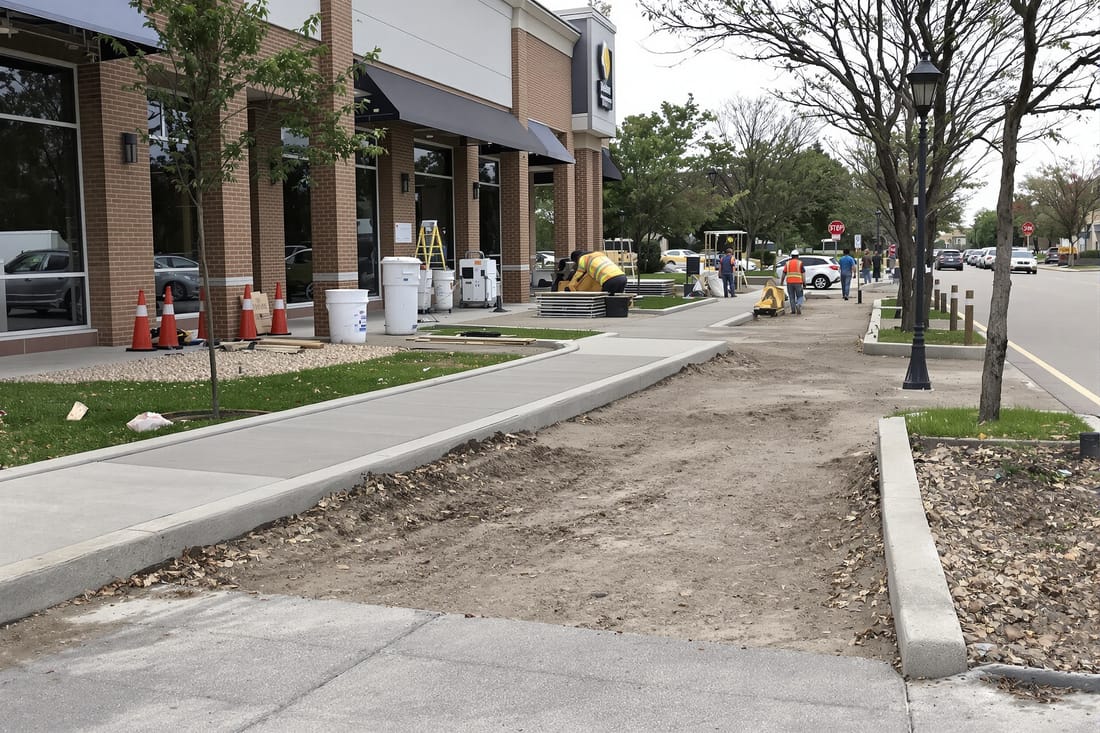
When you hire Superior Concrete Denver for a commercial concrete sidewalk, you are getting more than a basic walkway. We start with how your property is actually used. We look at foot traffic patterns, delivery routes, snow storage areas, nearby landscaping, and drainage so the layout works in real life, not just on paper. For retail centers on Colfax, office parks in the Tech Center, or industrial sites near I 70, the width, thickness, joint layout, and surface finish are tailored to how your customers and staff move.
Typical commercial concrete sidewalks in Denver are 4 to 6 inches thick, but that is only the starting point. For areas where carts, pallet jacks, or occasional vehicles will cross, we often recommend thicker sections or concrete with a higher compressive strength mix. We discuss broom finishes for slip resistance, troweled borders for a cleaner look, and color or integral hardeners when branding or upscale appearance matters.
Cold weather performance is critical in Colorado. We specify air entrained concrete that can handle freeze and thaw cycles, and we design expansion joints and control joints to minimize cracking from temperature swings. We also pay close attention to slope. A sidewalk that holds water in April will turn into an ice sheet in January. Our crews use longer straightedges and laser levels so water sheds predictably toward drains, not back toward your building or parking lot.
If you have an existing sidewalk that is failing, we assess why before we recommend replacement. Many Denver commercial sidewalks crack because the base was not compacted correctly or because downspouts discharge directly onto the concrete. In those cases, we address the root problem, for example adding or redirecting drainage and rebuilding the subgrade, so the new sidewalk lasts. We walk you through options and expected lifespan so you can plan capital improvements realistically, not just put a Band Aid on recurring issues.
Curbs and gutters that manage Colorado runoff the right way
Curbs are more than a visual border around your parking lot. For commercial properties in Denver, they are a key part of your drainage and snow management. Superior Concrete Denver evaluates where water comes from (roofs, adjacent properties, uphill streets) and where it needs to go. We then design curb lines, heights, and gutter slopes that move water efficiently to inlets and away from entrances and foundations.
Many older parking lots in Denver have settled or heaved, which breaks the connection between curbs, gutters, and the asphalt. Instead of simply replacing the visible concrete, we check elevations using a laser level and sometimes recommend minor regrading so the new curb and gutter actually function. This might include adjusting curb cuts, adding concrete pans where water crosses travel lanes, or thickening sections in heavy truck areas.
You can choose from standard 6 inch vertical curbs, rolled curbs for residential style access, or reinforced curbs in loading zones. We also consider plow impact. If your property uses heavy snow plow trucks, we may recommend reinforced curb ends, thicker curb faces at entrances, or slightly modified profiles that stand up better to repeated winter scraping.
For businesses along busy corridors like Federal or Colorado Boulevard, we coordinate with applicable city standards when the curb and gutter ties into public right of way. That includes matching city approved profiles, concrete strengths, and expansion joint spacing. Handling this correctly upfront prevents headaches later with inspectors or resurfacing projects. Our goal is a curb and gutter system that quietly does its job during spring storms and January thaws alike.
ADA compliant ramps and safe access for every visitor
Commercial concrete ramps in Denver have to look good and meet ADA requirements, and they still need to work in real snow and ice. Superior Concrete Denver designs and builds ramps with compliant slopes, landings, rail integrations, and detectable warning surfaces so your property is accessible and you reduce liability risk.
We start by reviewing existing grades. Sometimes we can create an ADA compliant route with a relatively short ramp and small landing. Other times, especially on sloped lots or older buildings, we need to rework surrounding sidewalk areas to keep slopes under the ADA maximum. We prepare simple layout sketches so you can see how the route will function for both wheelchair users and pedestrians carrying bags, backpacks, or pushing strollers.
Our crews set accurate forms and use string lines and lasers to achieve consistent slopes, usually targeting slightly under the maximum allowed to provide a safety margin. We typically use a medium broom finish perpendicular to the direction of travel for grip, and we pay attention to transitions at doors so there are no awkward lips that catch casters or create tripping hazards.
For curb ramps at parking lots, we coordinate with your striping contractor or handle layout ourselves. The location of accessible stalls, aisles, and the curb ramp must work together. We set truncated dome tiles or cast in place warning surfaces at the correct depth and orientation so they pass inspection. In winter, areas near ramps often get more deicer and shoveling, so we design the concrete mix and sealing strategy accordingly to handle more frequent freeze and thaw cycling without spalling.
How the commercial concrete sidewalk and sitework process works
From first call to final walkthrough, Superior Concrete Denver keeps the process straightforward so you can keep running your business. We usually start with a site visit, not just a phone quote. Our estimator walks the property with you, notes problem areas, measures thickness of existing concrete where possible, and asks about snow removal methods, delivery schedules, and any planned utility work. This helps avoid tearing out brand new concrete for a future project.
Next, we provide a written proposal that details slab thickness, reinforcement type (rebar or wire mesh if needed), concrete strength, finishing method, and joint layout. You see exactly what you are buying, which is important if you are comparing multiple bids that may differ in hidden ways like thickness or base preparation. We are also upfront about items that can affect the final cost, such as poor subgrade conditions, required city permits, or work inside the public right of way.
When you give the green light, we schedule around your business operations. For many Denver commercial projects, we pour in phases so you can keep at least one entrance or lane open at all times. We coordinate concrete deliveries to avoid rush hour and nearby school drop off times when possible. Our crew handles saw cutting of control joints at the proper time after placement to reduce random cracking, and we apply curing methods suited to the season. In summer, that means curing compounds or coverings to prevent rapid moisture loss. In colder months, that may include blankets or temporary heat to keep the concrete within acceptable curing temperatures.
We provide guidance on when you can safely open areas to foot traffic, carts, and vehicles. For example, typical commercial concrete sidewalks can usually handle foot traffic within a day, light carts shortly after, and heavier loads only after the concrete reaches a suitable early strength. At final walkthrough, we show you joint locations, drainage paths, and any maintenance tips specific to your site so there are no surprises after we leave.
What Denver property managers should know before hiring a sidewalk and ramp contractor
A commercial concrete sidewalk or ramp project in Denver is an investment that should last decades, so a low initial price is not always the best value. The largest cost drivers are removal and disposal of existing concrete or asphalt, site access and staging limits, thickness and reinforcement, required city inspections, and traffic control or phasing needs. A reputable contractor factors all of these in rather than leaving you with unexpected change orders.
Before you hire anyone, ask specifically how they handle subgrade preparation. In our climate, a properly compacted, well drained base often matters more than an extra half inch of concrete. We typically remove soft or organic soil, install and compact aggregate base where needed, and evaluate downspouts and landscape irrigation that might undermine the new work. You should also confirm that the mix design includes air entrainment suitable for exterior freeze and thaw conditions and that the contractor is familiar with Denver Public Works standards if the work touches the right of way.
Timing is another big factor. In Denver, the best months for new commercial concrete sidewalks, curbs, and ramps are usually April through October, when overnight temperatures stay above freezing and afternoon thunderstorms can be planned around. We do work outside that window when necessary, but cold weather placement requires blankets, hot water in the mix, and tighter scheduling, which can increase costs. If you know you have a large project near a school or retail center, planning 6 to 8 weeks ahead gives you better date options and minimizes disruption.
Ask about joints, sealers, and deicer compatibility. We recommend sawed control joints at predictable spacing, isolation joints at building connections, and periodic sealing once the concrete has cured sufficiently. Many commercial properties in Denver use magnesium chloride or similar deicers. While modern air entrained concrete handles these fairly well, we can discuss alternative products near high traffic ramp areas to reduce long term surface wear.
Superior Concrete Denver focuses on long term performance, clear communication, and realistic scheduling. When you understand how the work is actually done, you can choose a contractor and a scope of work that protect your property, your visitors, and your budget over the full life of your commercial concrete sidewalks, curbs, and ramps.