Home › Concrete Sidewalk and Walkway
Keep foot traffic safe and smooth with a new concrete sidewalk in Denver, CO. We remove damaged or uneven walks and replace them with properly sloped, reinforced concrete. From front entry paths to garden walkways, we design layouts that improve access and drainage. Enjoy clean, level concrete walkways that look great and reduce trip hazards around your home.
Superior Concrete Denver provides professional concrete sidewalk throughout Denver, CO, Colorado and the surrounding area. Our licensed, insured crew delivers safe, clean, on-time work with a free estimate before anything begins. Call (970) 648-8412 or request your free quote.
Durable Concrete Sidewalks for Denver Properties
A concrete sidewalk in Denver has to deal with freeze-thaw cycles, deicing salts, and heavy foot traffic. Superior Concrete Denver builds sidewalks and walkways specifically for Front Range conditions, focusing on proper base prep, drainage, and concrete mix so you are not dealing with trip hazards or crumbling edges a few winters later.
We install concrete sidewalks and walkways for single-family homes, duplexes, small commercial properties, and HOA communities across the Denver metro area. That includes city sidewalk replacement in older Denver neighborhoods, new walkways from driveway to front door, side yard access paths, and backyard patio connectors. We work around existing landscaping, irrigation lines, and structures so your new walkways fit your property instead of looking like an afterthought.
Our crew is used to tight urban sites, older alleys, and limited parking. We plan access for concrete trucks or use buggies and pumps when needed so we do not tear up your yard or disturb neighbors more than necessary. From the first site visit, we explain what can realistically be done with your space and budget, rather than promising something that will not pass inspection or hold up to Denver weather.
How We Build a Long-Lasting Concrete Sidewalk
Every concrete sidewalk project starts with a site evaluation. Superior Concrete Denver checks slope, existing drainage, soil stability, and any nearby structures or tree roots. If we are replacing an existing cracked or heaved walk, we usually saw cut the old concrete into sections, break it out with a jackhammer, and haul it away to a recycling facility.
Once the area is cleared, we excavate to the proper depth. In Denver, that typically means removing 4 to 8 inches of soil to make room for a compacted base and a 4 inch slab for residential walks, sometimes 5 to 6 inches for commercial or heavier use. We install a base of road base or Class 6 aggregate, then compact it in layers using a plate compactor. This step is critical, since many sidewalks crack early because the contractor skipped or rushed proper compaction.
We set forms using wood or steel, checking alignment, slope, and elevation with a level or laser. For most sidewalks we pitch the surface 2 percent away from the house or structures so water drains properly. Depending on the design, we may install welded wire mesh or #3 or #4 rebar, especially across driveways, near steps, or where soils are weaker or tree roots are nearby.
We then pour a concrete mix that is appropriate for Denver conditions, often a 4000 psi air-entrained mix that holds up better to freeze-thaw cycles and deicing chemicals. Control joints are cut or tooled at regular intervals, usually every 4 to 5 feet or 2 times the slab thickness in feet. Those joints control where the concrete will crack, so the cracks stay straight and narrow instead of random and ugly.
Finishing happens immediately after placement. We typically use a broom finish for sidewalks to provide slip resistance, then edge the slab to create clean lines and reduce chipping at the sides. If a decorative finish is planned, we adjust the process so color, stamping, or exposed aggregate turn out consistent without sacrificing strength or drainage.
Design Options for Walkways That Fit Your Property
A sidewalk does not have to be plain gray if that is not what you want. Superior Concrete Denver offers several design options that still function well in snow and ice. For many Denver homeowners, that means a standard broom finish with a colored border at the edges or around steps. Borders can be created with integral color in the concrete or by using a contrasting stamped band.
If you want a more decorative walkway to a front porch or backyard patio, we can install stamped concrete that mimics stone, brick, or slate. Stamped sidewalks still need the same thickness and base prep as standard walks, and we make sure joint spacing and layout work with the pattern so the surface holds up over time. We seal decorative sidewalks with a breathable sealer that is compatible with winter deicers, and we explain which products are safe to use on them.
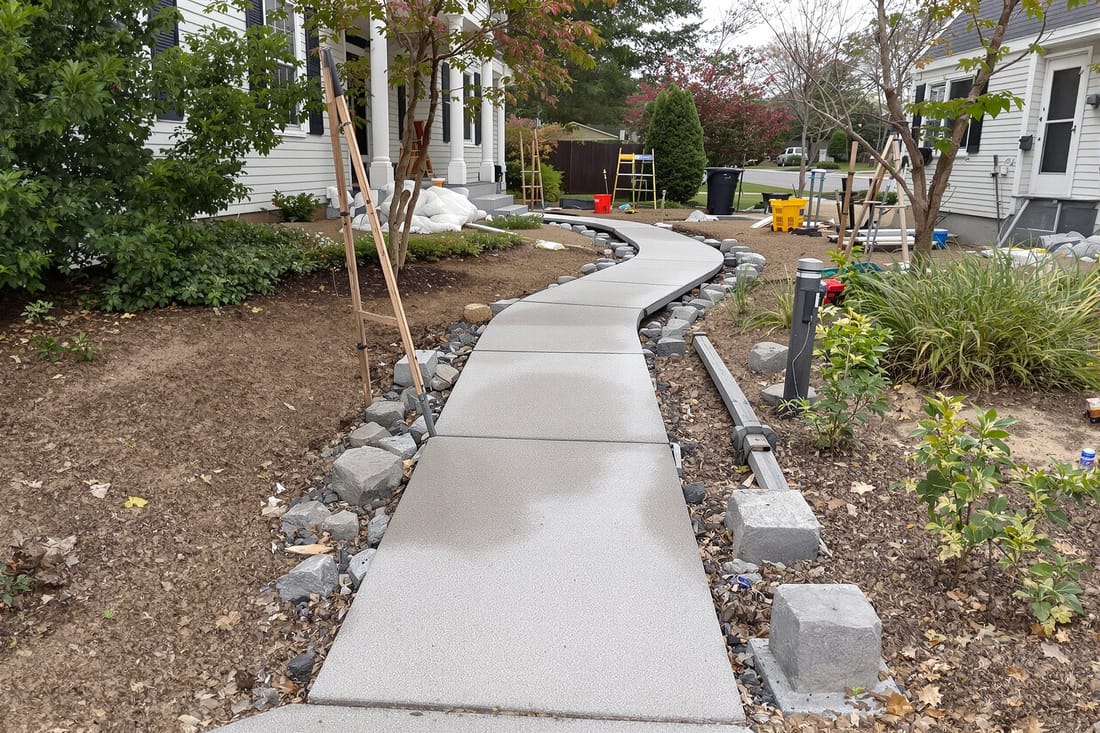
For older Denver neighborhoods with tree-lined streets, roots and limited width are common issues. In these cases we may recommend slightly wider sections in problem areas, strategic joint placement where future movement is likely, or using microfibers and reinforcement to reduce surface cracking. We can also vary the path layout with gentle curves instead of straight lines so it fits around existing trees or garden beds.
Accessibility matters too. When we design a front walkway or a path from the driveway to the entry, we look at slopes, step heights, and transitions so they are safe and comfortable for people of different ages and mobility levels. Where needed, we build low, consistent riser steps with concrete landings, or design no-step entries with gentle ramps that meet practical slopes for everyday use.
Permits, City Rules, and HOA Requirements in Denver
In Denver, sidewalk work in the public right of way is regulated. If the section you want to replace is between the curb and your property line, a permit and inspection are often required. Superior Concrete Denver helps identify where the right of way line is, then confirms whether a Denver Right of Way and Excavation permit is needed before work starts. We coordinate required inspections and make sure the new sidewalk meets city standards for thickness, width, and cross slope.
If you are in a nearby city like Aurora, Lakewood, or Englewood, requirements are slightly different, but the principle is the same. We check local standards for residential sidewalks, including minimum width, allowable grades, and when ADA ramps or truncated domes are required at corners or driveways.
For private sidewalks that are fully on your property, permits are sometimes not required for simple replacements, but HOAs may still have rules on finish, color, and alignment. We routinely work with HOA guidelines in Denver communities that want uniform gray finishes or prohibit certain patterns. Before we pour, we can provide a simple sketch or product sample that you can submit for HOA approval so there are no surprises.
We also pay attention to drainage rules. In many Denver lots, water must not be directed onto neighboring properties or public sidewalks. When we regrade a sidewalk or walkway, we look at how storm water will move after construction and, if needed, add small swales or drains so you do not end up dealing with ice sheets in winter or complaints from neighbors.
What Affects Concrete Sidewalk Cost in Denver
Concrete sidewalk pricing in Denver is driven by more than just square footage. During your estimate, Superior Concrete Denver breaks down the main factors so you understand where the numbers come from.
Access is one of the first considerations. Sidewalks along a street with easy truck access cost less than narrow side yard walks that require wheelbarrowing or using a concrete buggy around obstacles. Removal and disposal of old concrete, brick, or pavers adds cost, especially if the old material is thick or reinforced.
Thickness, reinforcement, and base prep also matter. A standard 4 inch thick residential sidewalk with a compacted aggregate base and no steel is the starting point. Heavier duty walks, thicker sections, added rebar, or deeper excavation and base materials for poor soil conditions will increase cost but may be necessary to prevent future failure.
Design choices can change the price too. Standard gray broom finish is the most budget friendly. Integral color, stamped patterns, exposed aggregate, or decorative borders require extra materials, labor, and sometimes additional sealing. On sloped sites or complicated layouts with curves, steps, or transitions to existing patios and driveways, there is usually more forming and finish time involved.
Finally, timing and weather play a role. Denver’s temperature swings and afternoon storms mean we schedule pours carefully to protect fresh concrete from rapid drying, freezing, or heavy rain. In colder months we may need blankets, accelerators, or other cold weather measures, which adds some cost but helps the concrete cure properly so it reaches full strength.
Common Sidewalk Problems We Solve and How to Get Started
Most of the sidewalk and walkway calls we get in Denver involve a few recurring problems: cracked slabs, trip hazards from heaving or settling, and spalling from deicing salts. Superior Concrete Denver evaluates whether partial repairs make sense or if full replacement is more cost effective. Hairline cracks without elevation changes can sometimes be managed with joint sealing or resurfacing. Slabs that have shifted or deteriorated at the surface often justify replacement, especially in high traffic or liability sensitive areas.
When tree roots are involved, we coordinate with you and, if necessary, an arborist about root pruning or changes to the sidewalk layout. We never simply pour a new walk directly over large roots and hope for the best, since that usually means more heaving in a few years. We may create root bridges, adjust alignment, or provide expansion space to accommodate movement.
The process to get started is straightforward. We visit your property, measure the area, check grades and access, and talk through exactly how you use the walkway. You receive a written proposal that outlines scope, thickness, base preparation, reinforcement, and finish details so you know what you are paying for. Once approved, we schedule removal, formwork, pouring, and cleanup over one or more days depending on size and complexity.
After the pour, we typically recommend at least 24 hours before light foot traffic and several days before moving anything heavy across the new concrete. We provide basic maintenance guidance specific to Denver conditions, including when to seal, what ice melt products are safe, and how to avoid early damage. The goal is a concrete sidewalk that functions safely, looks clean, and holds up for many winters with minimal hassle.